

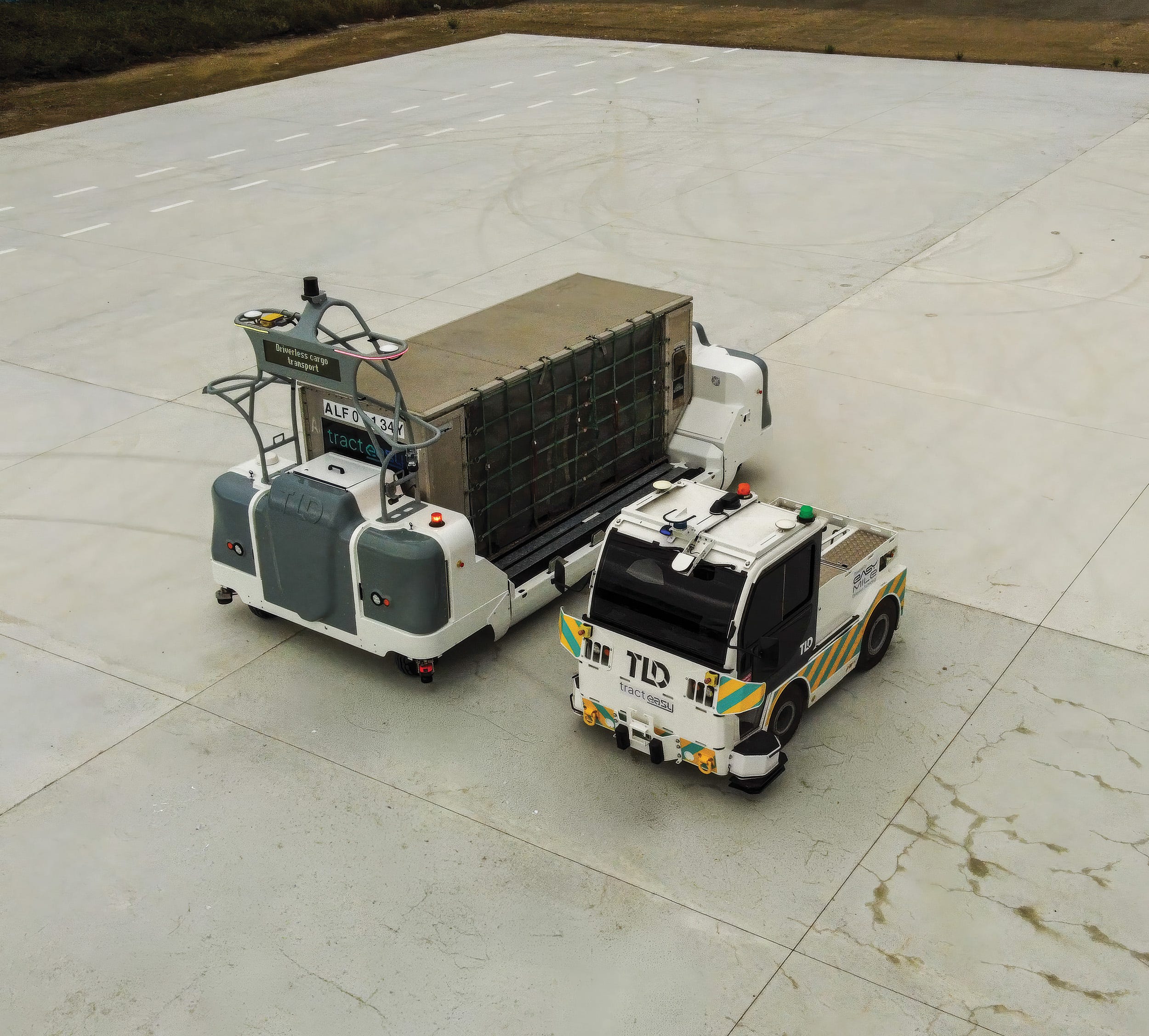
(photo credit TLD Robotics)
TLD Robotics, an ALVEST company focusing on autonomous ground operations, today announced its launch. TLD combines EasyMile and TractEasy into TLD’s driverless activities. This is a strategic milestone following ALVEST’s acquisition of technology leader EasyMile.
As TLD puts it, this “brings together autonomous software, industrial vehicle capacity, deployment expertise and customer support in a single, integrated business built to deploy autonomous operations at scale.”
This unified structure develops both the vehicles and software as one, to plan, build, deploy and scale autonomous operations across airports and industrial sites worldwide.
Led by Richard Reno as Chief Executive Officer, TLD Robotics operates under the ALVEST Group and brings together capabilities that previously existed across EasyMile and TLD, and were deployed commercially via the TractEasy joint venture.
The launch follows almost a decade of collaboration between TLD and EasyMile. Together, they saw an opportunity to advance beyond basic vehicle automation to fundamentally change how baggage, cargo and materials move across airports and industrial facilities.
The growth has been impressive, with 35 operations across 10 countries and more than 50,000 autonomous missions in real-world operations. Many of these sites now run 24 hours a day, seven days a week.
Of note, TLD sees its fleet tripling every year. The company is now more than a year ahead of previous projections.
“When TLD and EasyMile began working together in 2017, autonomous GSE was still seen as a future concept,” said Mr. Reno. “We saw the opportunity in structured environments like airports and logistics hubs early and have turned that vision into a proven business. Since creating TractEasy three years ago, we have scaled tenfold. With TLD Robotics bringing the same vehicles, teams and proven deployment record under one name, backed by a strong industrial base, we now have the platform and ambition to scale another 10x over the coming years.”
Customers include dnata, BMW Group Dingolfing, Daimler Truck AG, Bosch, John Deere, Munich and Narita Airports, and Lufthansa Cargo while a global network of engineering, deployment and customer support teams provides local expertise across North America, Europe, Asia and the Middle East.
TLD asserts that customers want a single partner capable of designing, deploying and supporting complete autonomous operations at scale every capability required to deliver autonomy at scale sits within one organization:
• Supervision Software to optimize and coordinate autonomous missions at the fleet level, while managing the integration in the traffic and its environment. Benefitting from XOPS expertise, the supervision software is deeply integrated in the airport environment
• On-Board Software to help each vehicle perceive, move and respond safely in real time.
• Purpose-built vehicle platforms, designed for demanding airport and industrial environments and fully integrated with the software to manage an integrated safety concept.
• Fleet & Operation Management to supervise, orchestrate and optimize live autonomous operations.
• Industrial manufacturing and service capabilities of TLD, the world GSE largest manufacturer with 12 factories in 7 countries.
• Integrated R&D across software, hardware, supervision & fleet management and next-generation autonomous solutions.
Backed by ALVEST’s financial stability, global manufacturing footprint and long-term outlook, TLD Robotics is uniquely positioned to accelerate the deployment of autonomous solutions for airports, logistics and industrial applications while continuing to develop the next generation of autonomous vehicle platforms.
“Automation is the future of our business,” said Valentin Schmitt, President & CEO of ALVEST. “Every operator we work with faces the same pressures: safety, labor availability, cost and decarbonization. Autonomy addresses them all and is a natural extension of our Leaner & Greener strategy. ALVEST brings the long-term ambition, industrial strength and financial capacity to deploy at scale. Our customers are not buying a pilot; they are investing in decades of operations - and that is the timeframe ALVEST is built for.”
Bishop’s Take
Consolidation is good. It shows a maturing of the autonomy space. I expect to see more of this over the next couple of years, as an alternative to IPO’s.
The airport and industrial space will quietly implement this tech because it lowers cost. Be on the lookout next time you’re on a plane taxiing to the runway --- it won’t be long until you see AV’s serenely doing their jobs on the tarmac.