

This year’s North American summer conference scene has been dominated by two major conferences. In late June, the 2026 Autonomous Trucking Conference, in its third year, brought together truck AV developers and a broad spectrum of stakeholders from the upper Midwest, as well as Canada, to Fargo, North Dakota. In late July, the Automated Transportation Symposium, sponsored by SAE, convened in San Diego. The elder statesperson of the AV space, the ATS event in various forms has been meeting annually since 2013.
With this Part 1, I provide insights for the Autonomous Trucking Conference. In an upcoming Part 2, I’ll cover the Automated Transportation Symposium.
2026 Autonomous Trucking Conference
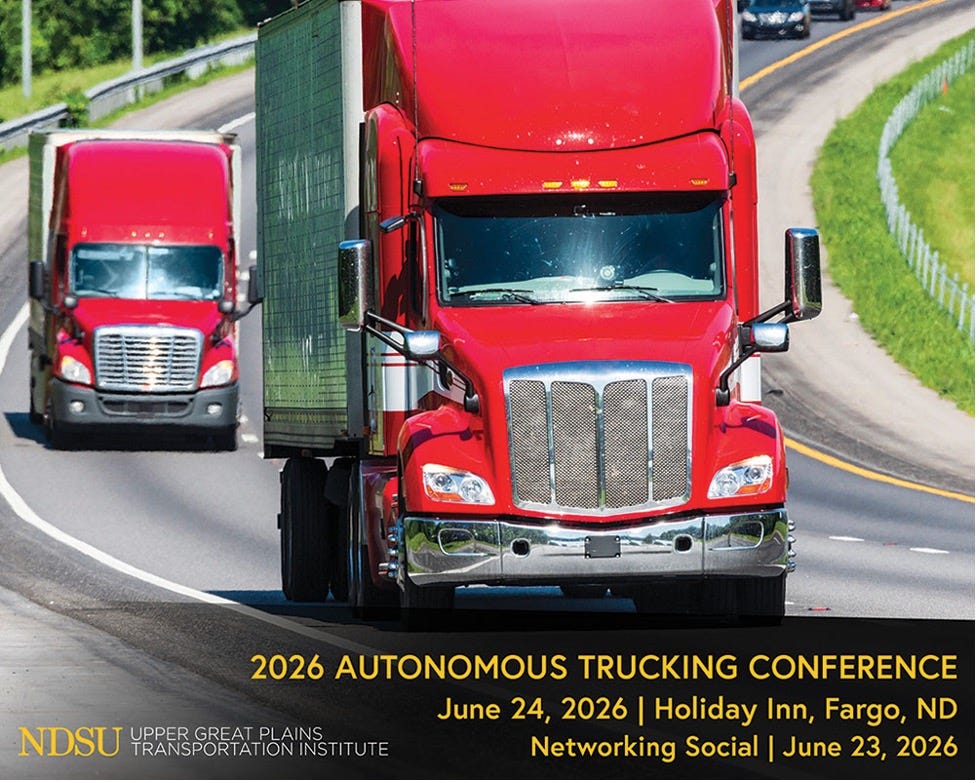
Each year since 2024, Dr. Denver Tolliver, Director, Upper Great Plains Transportation Institute at North Dakota State University, has organized this conference, which is supported in part by a grant from the Federal Motor Carrier Safety Administration within USDOT.
From his perch in the northern region of the U.S., Dr. Tolliver saw the need for autonomous trucking in the region and aimed to champion deployments there. I was pleased to be part of a small team organizing the event, along with Alex Rudin, Autonomy Policy and Strategy Group Lead at MITRE.
Each year the crowd has grown, the breadth of stakeholders expanded, and the roster of highly placed speakers has ratcheted up. This year’s attendance was upwards of 120 people. As noted on the UGPTI website, participants included some of the leading autonomous truck developers in the United States and Canada, the Commercial Vehicle Safety Alliance, state departments of transportation, state law enforcement officers, original equipment manufacturers, and AT industry partners.
In his opening comments at the event, Dr. Tolliver said the conference was motivated by observing the extensive truck AV deployments in the U.S. Southwest. Certain that deployments would spread geographically, he saw the value in preparing Upper Great Plains stakeholders for this eventuality. Once the USDOT grant was in place, he was off and running.
With multiple AV Trucking companies in attendance, the regional attendees had the opportunity to get a direct sense of what autonomous trucking operations are all about. The event organizers were also well aware of Canada’s allowance of autonomous operations in Ontario (see below), which creates even more urgency to prepare northern U.S. trucking operations for cross-border operations.
The UGPTI webpage is a treasure trove, providing the Conference Program, Conference Recap and Speaker Interviews (video), and Session Recordings (video).
Opening Keynote from USDOT
There was high anticipation in the room when Michael Hampton, Assistant Administrator and Senior Policy Advisor Federal Motor Carrier Safety Administration, came to the podium for the opening keynote. This was the first time such a high ranking USDOT official had addressed the group. Mr. Hampton joined FMCSA in early 2025, after a five-year stint at the National Transportation Safety Board.
He put forth a clear vision for bringing autonomous trucking operations into reality in the U.S., while stressing the need for guardrails. Here are some key excerpts. While I hesitate to include so much content from one speaker, the tone and depth expressed here is unprecedented. Here goes….
Emphasizing FMCSA being a safety-first agency, Mr. Hampton laid out where they stand. “The conversation is no longer about whether autonomous trucking is possible. It’s about how deployment will happen safely, responsibly, and at scale,” adding that “We shouldn’t assume that today’s system is as safe as it can be, just because it is familiar. That lesson is especially relevant as we think about commercial autonomous trucking.”
“Today’s road operations result in crashes caused by human factors such as fatigue, distraction, and impairment. Those risks have become part of the baseline we’ve come to accept, which includes 40,000 fatalities on the roads annually” in the U.S.
How to proceed with the radical new tool of autonomy? “The promise of autonomous driving systems is that they may be able to reduce some of those risks. That does not mean it is without risk, nor does it mean they deserve treatment . It means they deserve careful, objective evaluation based on the data. At the FMCSA, our mission is not to promote any particular technology. Our responsibility is to ensure every commercial motor vehicle operating on America’s roadways, whether human driven or automated, does so safely.”
Autonomous trucking was once a distant possibility. He noted that “For years, we discussed autonomous technology of the future, planning how FMCSA would oversee them once they eventually arrived. That future has arrived. The industry is already moving from pilot programs to commercial reality, and FMCSA’s responsibility and oversight must evolve alongside it. ADS-equipped motor carriers are operating on public roads and delivering freight today. In other words, the era of private projects has given way to the era of commercial operations.”
Thus, he continued, “FMCSA’s responsibility is no longer theoretical. It is real. Our job is to provide effective safety oversight while ensuring our regulatory framework keeps pace with technological innovation. Automated trucking… is here today and it will continue to grow and scale. The question is not whether this technology will advance but whether government, industry, the safety community, and enforcement personnel will work together to ensure it advances responsibly.”
With this preamble, he got down to guiding principles and had plenty to say about FMCSA’s decisions (or lack thereof) during the Biden administration.
“The Department’s approach is guided by three core principles. Number one – to prioritize the safety of ongoing automated vehicle operations on public roads. Two, to remove unnecessary barriers that slow responsible innovation. And third, to enable commercial deployment where it can enhance safety, mobility, and economic opportunity.”
He summed up their approach succinctly. “These principles reflect an important shift in the mindset. Government should not stand in the way of innovation simply because technology evolves faster than regulation. At the same time, innovation should never move faster than safety.”
The temperature rose substantially (and for good reason in my opinion), when he addressed an AV industry request dating back to 2023. Industry sought an alternative to the Federal regulation that, if a truck is stranded on the side of the ride, the driver must exit the vehicle and place three “warning triangles” behind the truck at a fixed distance, as a warning to oncoming traffic.
“Let’s be honest about the history. Aurora submitted an exemption request to use cab-mounted warning beacons instead of traditional reflective triangles. While a safety analysis needed to be completed, of course, this was on its face a straightforward request. How can an autonomous truck place three triangles if there is not a human driver? But under the previous administration, that request sat with the Agency for years without a determination. That should never have happened. When a decision was finally made, it wasn’t a compromise, it was complete denial. Despite studies that showed in certain scenarios that cab-based beacons could be safer than the triangles, they said no to everything.”
He painted the picture vividly. “Now let’s break this down. Highly capable engineers, developers, and safety experts combined to develop an AV truck. This truck can begin at a terminal in Houston and pull out onto local roads. It can handle the intersections and traffic lights to reach the on-ramp. It turns on to the on-ramp, speeds up, and seamlessly merges with Texas highway traffic, which is no easy feat. The truck then drives more than 200 miles north towards Dallas, passing slower cars, navigating construction zones, and managing poor drivers. When it gets to the town of Palmer, the truck signals, slows down, takes the exit, and navigates the final turns into the terminal.”
Then, turning back to the issue at hand: “It wasn’t the autonomy operation that prevented deployment in that moment: it was three plastic triangles. The previous administration chose to block progress rather than finding a solution. Starting in 2025, FMCSA took a fresh look. We asked ourselves, how do we get to yes, safely? In October, we granted a limited waiver to Aurora. Where others were entangled by bureaucracy, we found a way to enable deployment while maintaining safety. Both can be achieved.”
Mr. Hampton then described FMCSA’s way forward. “First, we narrowed the scope. The original request was industry-wide. FMCSA’s waiver required companies to certify that they will follow the strict waiver requirements, which allowed FMCSA to note who was operating under the waiver and to monitor that safety performance. Second, we focused on the safest roads, i.e. the U.S. interstate system; the previous denial cited concerns about the visibility on sharp curves and hill crests; but by restricting operations to primarily interstates where road geometry was standardized, we mitigated that risk. Third, we addressed safety concerns that were raised in public comments about a redundant power source, so we required a redundant power source. And finally, we added data reporting requirements, so if a crash occurred, we would know about it. Each operator using the waiver is required to report the critical safety data, including the activations of the beacons, how long it was activated, and for what reason to FMCSA every 90 days. That real world on-road data is necessary to write the permanent rules of the future.”
With firmness, he noted that “This is how government should work. We didn’t block innovation and we didn’t compromise safety. This is how we are looking at autonomous trucking. There’s an opportunity to allow innovation while ensuring safety.”
The warning triangle exemption is relatively straightforward example, but other issues can be more challenging. “One waiver is not enough,” said Mr. Hampton. “As this industry moves from pilots to widespread commercial deployment, it needs more than case-by-case decisions. It needs regulatory certainty. Innovation stalls when companies must navigate a patchwork of conflicting rules across jurisdictions. Delivering that certainty requires a unified approach, because no single agency can shape the future of automated transportation alone. That is why FMCSA is working with the Department’s NET Council, which is comprised of NHTSA, the FAA, the FTA, and other modal partners. And together we are developing the department’s national automated vehicles strategy to provide consistency and clear expectations nationwide.”
He then addressed the industry actors, saying “Government oversight alone will never be enough to ensure the perfect safety of the traveling public. The safety and the long-term success of the industry depends just as much on the safety culture inside every company. Safety cannot be a compliance requirement mandated by the Federal government or by the states. It has to be a core value within each organization. The decisions your engineers make, the testing protocols your companies establish, the operational limits you set, and the transparency you demonstrate will shape public confidence in the technology.”
Doubling down, “Every company operating in this space represents the industry as a whole. In the beginning, as these initial deployments are happening, the public will not distinguish between the safety of one developer compared to another. Public trust will be built or torn down by every deployment, every interaction, and every operational decision from each of you. That trust is one of the industry’s most valuable assets, but it can be easily lost. And building that public trust also requires good data, and effective oversight depends on research, operational experience, and continued engagement with the industry, first responders, state partners, and the research community.”
Looking forward, Mr. Hampton described FMCSA’s research agenda by framing three key questions.
· How do we establish meaningful safety benchmarks and monitor ongoing safety performance?
· How should roadside inspections and emergency response evolve with the introduction of autonomous trucking?
· How can technologies surrounding the truck, from connected infrastructure to smart trailers, improve safety?
Yes, a lot of content, but worthwhile to present here. What’s remarkable to me is the full-throated statements and confidence in AV technology from Mr. Hampton, compared to only cautious (or no) statements in the previous Presidential administration.
My simple analysis of Biden’s FMCSA: autonomy was tied to loss of trucker jobs, a big no-go in the Washington of the day. Having their fingerprints on a decision supporting autonomy was not going to happen. That said, I’m confident FMCSA staff evaluated a wide range of options, including ways to reach a “yes.” Sadly, the political decision-makers felt otherwise.
Cross Border Autonomous Trucking Operations At The Northern Border
Following the USDOT keynote, the conversation turned international with a panel focusing on eventual cross-border autonomous truck operations between Canada and the U.S. The panel consisted of Andrew Phillips, representing the Motor Vehicle and Road Safety Director at Transport Canada; Rich Steiner, VP of Government Relations and Public Affairs at Gatik; and Katelyn Magney-Miller, Communications Director at Partners for Automated Vehicle Education (PAVE).
Over these many years of AV trucking development, I believe this is the first time in any conference that the topic of Canada-U.S. border crossings has been specifically addressed. Great to see, and timely!
Autonomous trucking in Canada is nothing new, with commercial deployment driven largely by partnerships between retailers and autonomous freight technology firms. Ontario’s Automated Commercial Motor Vehicle Pilot Program, which provides a uniform regulatory foundation, went into effect this time last year.
PAVE is a unique organization, consisting of over 90 members including vehicle manufacturers, Tier 1 suppliers, automated vehicle deployers, the public sector, and others. Ms. Magney-Miller noted that the aim of PAVE is to educate the public and the public sector on all things automated driving. She stressed that the public needs to be on board, noting “we have a way to go in building public trust.”
Mr. Phillips described responsibilities at the federal, provincial, and municipal levels in Canada, noting that the federal level regulates regulate new vehicles, including cross-border operations. In addition to on-road autonomous operations, he also noted activity in mining and forestry.
“We hope that with time the deployment of automated vehicles can help to drastically reduce road fatalities,” he said, noting that there are 20,000 fatalities per year in Canada, of which 20% involve commercial vehicles. He emphasized that automated technology poses its own safety risks “and we need to think about how we will adapt our safety regime to support that,” remarking that he was very much in agreement with Mr. Hampton’s remarks. He added that “regulatory flexibility and exemptions can support innovation; safety and innovation are not exclusive objectives.”
Noting that the provinces have authority when it comes to operating autonomous vehicles, he described pilot programs in Alberta, British Columbia, Quebec, and Ontario, with the majority of activity happening in Ontario.
There have been 25 on-road trials of autonomy to date in Canada. In fact, Transport Canada initiated truck platooning trials way back in 2017, examining fuel economy benefits. Platooning remains active with Kratos trials in the forestry sector. A new initiative involves Kodiak operating their AV’s in Alberta, supporting the West Fraser Timber Company.
Mr. Phillips did the audience a favor by explaining the role of the United Nations World Forum for the Harmonization of Vehicle Regulations (WP.29), which has been active for the last eight years addressing ADAS and fully automated driving. He was pleased to note that the Global Technical Regulation for automated driving has recently been officially adopted. While “far from perfect,” he said, “We see this as the first step, and the regulations will evolve significantly over time. He added that the GTR doesn’t oblige Canada to adopt the regulatory standard verbatim. A key objective for Transport Canada is to preserve alignment with regulations with the U.S. as much as possible. As well, the provinces want to see Federal leadership in regulatory development. In closing, he remarked that “Industry is increasingly signaling a readiness to come to Canada and we want to be ready for that.”
AV-wise, Gatik looms large in Canada, launching Canada’s first fully driverless fleet in 2022. In the U.S., Gatik is running their autonomous freight vehicles in Arkansas, Texas, Arizona, Nebraska, and Iowa. Mr. Steiner noted that “this is not science fiction from a garage in Silicon Valley. This is a commercial operation that is live today. With PepsiCo and Loblaws, we have over 100 vehicles in operations with no human in the vehicle.”
He emphasized the evolution of goods delivery, with customers wanting higher speed, higher frequency, lower cost, and availability close to home. As he put it, “We want stuff yesterday” and autonomous freight plays a pivotal role. “Fast forward five to ten years down the line, Gatik is going to be operating thousands, tens of thousands, hundreds of thousands of autonomous trucks, delivering goods at locations where you and I can go pick stuff up. This will be incredibly normal, integrated into society, safely delivering goods where and when we need them.”
Mr. Steiner provided a full description of Gatik’s approach and operations during an afternoon session, which can be found on the conference website.
In this cross-border panel, he described Ontario’s approach to allowing autonomy as “hyper-structured with smaller, more incremental steps.” Within this framework, Gatik has transitioned from driver-in to driver-out operations, as well as moving from lower risk routes to more challenging routes.
In response to an audience question about autonomy operating in challenging winter weather, Mr. Steiner emphasized that Gatik, based in Canada, has operated their autonomous trucks for six winters in Ontario so far. “We have matured our technology to such a point where it is perfectly capable operating safely within snow, rain, freezing rain, and fog. We use a fully redundant sensor suite which provides a 360-degree awareness of
the environment at a range of seven football fields, day or night, with no blind spots. We can see perfectly in very bad conditions while at the same time we take a very defensive style of driving.”
Returning to the discussion on public perception earlier in the session, as raised by Ms. Magney-Miller, Mr. Steiner noted that “typically at the beginning of launching AV trucks traveling local streets, it can be somewhat jarring to the public. Over time, you might see people sometimes waving at the vehicle. The autonomous vehicles become integrated into community life.”
He closed by noting that with 50 trucks operating in Ontario, Gatik is now supporting 300 Loblaws stores across the Toronto area. “Safety is the ultimate goal,” he said. “The province is comfortable and the public is comfortable.”
As to the cross-border question: based on my observations over the years, Ontario is typically the first mover in regulatory and legislation for new tech. I surmise that the other U.S.-adjacent provinces will follow suit over time. The panel was upbeat regarding this prospect as activity in the northern U.S. and southern Canada evolves.
Federal Framework and Multistate Operations
The conference program noted that, with intrastate operations of autonomous trucks gaining momentum in the United States, interstate operations are necessary before long-haul hub-to-hub traffic can expand beyond its current footprint. To achieve this outcome, regulations must be aligned across states and with the federal government to support widespread operations.
In this session, Cory Johnson, ITS Program Manager at Minnesota Department of Transportation, Amanda Abruzzo, Senior Operations Administrator at Arizona DOT, and Eric Belford, Montana Administrator for the Motor Carrier Services Division discussed opportunities for coordination across states and how state regulatory approaches will be complemented by emerging federal regulations.
Mr. Belford noted that Montana was a trend-setter back in the day, passing one of the earliest platooning allowing bills. He emphasized that Montana seeks to be a testbed for winter weather as well as for animal incursions onto highways. “We’re a Vision Zero state,” he noted. “That means zero deaths and serious injuries. If we’re going to get there, we need autonomy.”
Mr. Johnson said, “With Minnesota being silent on autonomous operations, we require a driver in the vehicle.” The state is currently identifying gaps in regulatory rules and policies.
“During 2025, we embarked on outreach to developers and stakeholders and established a Governor’s Council which is played a role in educating legislators for an upcoming session where autonomy legislation was taken up,” he said. By far, lawmaker discussions focused more on robotaxis than trucking; there was no specific Level 4 AV trucking focus. Mr. Johnson noted that seven different bills came up, of which two were supportive. A bill to allow truck platooning was introduced. Another bill aimed to establish an Advisory Board. The bill with the most momentum called for the creation of an Impact Advisory Task Force.
Overall, learning was a major theme for the legislators. But Mr. Johnson observed that “None of that stuff actually moved forward so we’re still kind of where we landed at the beginning of the session. This offers MNDOT a chance to continue to learn, try to educate through doing pilots and projects to keep the conversation going. “
Ms. Abruzzo discussed Arizona’s journey as an early adopter for AV operations of all types, cars and trucks. “We continue to explore what info is needed from operators, including safety metrics,” she said. Her main message was that “If communication is not happening, nothing is happening.” Continuing, “We have to educate ourselves. Ignorance is lack of knowledge. As humans, if we don’t understand something, we fear it. So with this conference and others like it, we have the opportunity to educate legislators and the public.”
Equipment Manufacturers’ Plans for Producing New Autonomous Trucks
I was asked to provide a perspective on commercial considerations for Automated Trucks as they become integrated into the supply chain of bringing this tech to the trucking mass market. Several AT companies are working with and/or have long-term partnership agreements with original equipment manufacturers (OEMs). Next year, fully autonomous trucks will be available for purchase from OEMs, which is expected to lead to widespread commercial adoption.
The full presentation can be downloaded here.
I first noted an important synergy between robotaxis and trucking. Robotaxis entered commercial operations sooner than trucks. Waymo, the leader, operates 500,000 rides per week with a fleet of 4000 vehicles; they have completed more than 170 million fully autonomous miles. Even though robotaxis are not carrying freight, they are affecting public acceptance, which – by my reckoning - is generally quite good. This provides a public-acceptance tailwind for automated trucks as they become more numerous on highways and streets.
Then it was time to go to school, with a lesson on the OEM-sourced approach, termed Driver-as-a-Service, and the go-it-on-your-own approach, i.e. Transportation-as-a-Service.
The Driver-as-a-Service business model, or DaaS, entails the AV developers acting as suppliers to OEMs. Freight carriers buy trucks from OEMs with “a driver inside,” i.e. autonomy.
Another business model is a go-it-your-own approach, in which AV developers purchase trucks and upfit them for autonomy. With Transportation-as-a-Service (TaaS), freight
shippers buy freight capacity from these autonomous trucking companies, as they would with any other freight carrier… except that the per-mile rate is lower.
Under the DaaS model, fleets access autonomy via purchasing trucks with ongoing support from OEM. Trucking fleets typically have a long history with their preferred OEM truck suppliers; they will take great comfort in this new tech being backed by a long-time truck manufacturer partner. But if you just care about moving freight, the TaaS approach offers an entirely self-contained freight transportation solution. All the messy bits of integrating autonomy are handled by the Taas-er, while the shipper enjoys a lower per-mile rate.
As detailed in the presentation, there are numerous truck manufacturer partnerships with autonomy providers. Three OEMs, Daimler (partnered with Torc), TRATON (partnered with PlusAI for introduction on the International brand), and Volvo (partnering with Volvo Autonomous Solutions, Aurora, and Waabi) have stated that the first factory-built autonomous trucks ready to be sold to customers will arrive next year.
Aurora will likely have thousands of vehicles operating, and Volvo Autonomous Solutions intends to scale up to more than 300 AVs by the end of 2027.
When it comes to the TaaS guys, long-haul autonomous loads are being offered by Bot Auto and Kodiak. In short haul B2B settings, Einride and Gatik are operating in this manner.
It will be fascinating to monitor the rollout of these two business models, as well as hybrids that will likely evolve. Bottom line, these offerings need to offer rock solid safety and operational performance, while fulfilling their promises of lower freight rates. Even though shippers and truckers are not known to be chatty about such things, I’m hoping some interesting results will be shared by this time next year.
Inspection and Safety Enforcement
Enhanced safety inspections for autonomous trucks ensure that these driverless vehicles meet regulatory requirements, maintain safe operations, and are integrated safely into the existing freight network. In this session, a panel of safety experts described developments in safety enforcement and enhanced inspections in the United States and Canada and potential protocols for cross-border movements. Panelists were John Sova, Roadside Inspection Specialist, Commercial Vehicle Safety Alliance, and Richard Russell, Senior Manager First Responder Programs and Policy, at Torc Robotics.
Mr. Russell, a former state trooper, noted that in that world “We hate change, and also don’t like the way things are.”
CVSA and ATA’s Technology and Maintenance Council worked up solutions that would support depot inspections rather than roadside inspections, which would create challenges for both the truck operator and the officer. That said, an enforcement official always retains the option to pull over a driverless vehicle if an obvious safety issue is noticed. Otherwise, inspection data is passed along to enforcement personnel wirelessly as the truck travels. Mr. Russell noted that “the AV inspections mean these vehicles are the safest on the road.”
He added that “Apprehension is lack of knowledge, so we address concerns for regulators. I trained over 300 fire fighters and Law Enforcement personnel last year.” His bottom line regarding autonomous trucking: “I truly believe this is going to save lives.”
Within CVSA, Mr. Sova is staff liaison for Enforcement Industry and Modernization Committee – a body which is critical to how law enforcement treats autonomous trucks. Leveraging his 21 years with the highway patrol, he’s been a key part in evolving inspection protocols going back to 2018 when AV developers and CVSA started a working group.
He was pleased to note “It’s here – we have a solution.” The details are very geeky, but in essence CVSA certifies non-enforcement persons to perform depot inspections.
Overall, as autonomous vehicles are being more deployed, law enforcement becomes more familiar with it. His message to the Law Enforcement reps in the room: “AVs are here, especially in Texas and they will be coming to the north in time. We need to think outside the box. Don’t be afraid if it. Educate yourself about it.”
Platooning
Truck platooning in highly-automated mode is being increasingly utilized in agricultural and natural resources industries. For example, leader follower platoons are being demonstrated in the Ohio/Indiana I-70 Corridor and in movements of agricultural goods in the Northern Plains and forestry products in Canada, some of which are occurring under challenging conditions (e.g., steep grades, low GPS connectivity, dust, and harsh weather).
This session examined current platooning operations in North America, advances in platooning technology, the potential for new platooning operations, and impediments to widespread deployment. Eric Belford of Montana DOT and Maynard Factor, Vice President, Business Development, Kratos Defense provided recent updates and plans looking forward.
Building on his reporting of results of the 2025 MT legislative session during an earlier panel, Mr. Belford noted House Bill 97 on platooning was passed into law. It required a feasibility study. The University of North Dakota and MT DOT performed this study, which addressed terrain, weather, and other factors. The study concluded this effort with a determination that platooning is feasible in Montana. Based on this, the law calls for MT DOT to adopt rules and standards for platooning, which includes stakeholder engagement. A platoon permit will be required, with operations restricted to interstate highway operations, as well as non-interstate operations based on specific approvals. Platoons are limited to three or less vehicles.
Separately from platooning, Senate Bill 67, which also passed in 2025, calls for stakeholder engagement focused on any type of Level 4 vehicle, leading to rules for both autonomous light vehicles and truck operations.
Kratos is the primary platoon-oriented player in North America. Mr. Factor provided information on their “versatile auto-platooning solution, adaptable across multiple industries within challenging environments.” This includes truck-mounted attenuators for use in highway work zones (18 systems are deployed nationwide), as well as agricultural hauling.
Kratos has carried loads with their platoons on interstate highways at a small scale. But off-interstate is where the company is most active.
Several tractor-trailers in leader-follower platooning configuration have been deployed for agricultural customers in Minnesota and North Dakota, with a human driven lead vehicle and a driverless follower. Running on two-lane county roads, Kratos is hauling agricultural commodities (sugar beets) under contract with the Minn-Dak Farmers Cooperative.
North Dakota officials have allowed this use of platooning, but since Minnesota only allows testing on interstate highways, running on MN rural roads must be done with drivers in both vehicles. While not ideal, these operations enable Kratos to collect valuable operational data.
Kratos has been running sugar beets for several seasons. Mr. Factor said that “We’ve seen good feedback from users and will be running in the 2026-27 season.”
Growth in Level 4 Autonomous Trucking
In the closing session, Dr. Tolliver led a discussion with Richard Russell of Torc Robotics and myself. The session was quickly opened up to the audience, which posed a variety of questions. The back-and-forth is worthwhile to watch.
In the last year or so, I’ve been hearing one question in particular in various venues: how do researchers and analysts access safety metrics from the companies that are now running on-road? The question – quite valid – was raised during this session. I didn’t give Mr. Russell a chance to reply and jumped immediately on the question. “You won’t,” I said, “because this information is proprietary. It’s very different from activity in the robotaxi space, in part because the users there are retail customers and trust must be earned.” This doesn’t mean truck autonomy wont be held to account: it will just be happening behind closed doors. “This is the case for most any business-to-business activity. However, within trucking circles, the word will get around the trucking space if there are problems about a particular autonomy system. Importantly, the OEMs will ride herd as well – they will be in the hot seat with their customers if performance is sub-par.”
Once I got off my soapbox, Richard Russell noted that the inspection process will take care of the vast majority of what could have been mechanical issues.
CONCLUSION
This conference really wasn’t aimed at teaching people things; it was instead a forum to get people talking to each other and understand one another’s perspectives. The 2026 Autonomous Trucking Conference brought together the AV trucking industry, freight carriers, state regulators and policy makers to focus on communication with the public and build trust.
This is even more important for those not working day to day in the AV industry. At an event like this, attendees can learn and be ambassadors to take back to their home territory. This is why is it important to have these conferences to spread the word.
UGPTI is seeking further funding to keep these events going forward, with tentative plans to host a 2027 forum. Keep an eye on their website for updates.
Richard Bishop is an Advisor to and/or shareholder related to the following autonomous trucking companies: Aurora, Forterra, Gatik, Outrider, and PlusAI.